The essence of Artificial Intelligence has penetrated every niche and gained a prominent part in automating serious aspects that were tedious and human–centric. CAD to BIM model conversion has embraced the revolution and started to adopt AI in various aspects, particularly in automating distinctive parts that were hard and time–consuming. Therefore, in this blog, we envision the impact of AI automation and how it does CAD to BIM data cleaning, data mapping, and model translation.
AI’s Collective impact on model conversion
Let’s understand how AI impacts the CAD to BIM model conversion as it collectively streamlines the whole process and reduces manual intervention. Artificial Intelligence assists the scopes such as data cleaning, data mapping, and model translation in different ways.
AI cleans messy design data, automates the CAD data mapping to the respective BIM elements and speeds up the model translation where the designs become simulation-ready assets.
AI can break the stereotypical model conversion methods and boost the whole process as it replaces manual efforts in multiple zones and streamlines model conversion while preserving accuracy in all areas.
How AI shows distinctiveness in model conversion methods!
As we mentioned, AI impacts model conversion in diverse parts and methods, here are the specific areas where AI can apparently behave as a catalyst and improve the whole process.
AI-Driven Data Cleaning
The CAD models are ideally heavy, incorporating complex mechanics and proprietary component details. When imported into BIM environments, this dense geometry data retards the performance
AI solves this by automatically streamlining heavy models for Building Information Modeling (BIM) environments through the following core pillars:
- Reducing Model Density: By leveraging machine learning (ML) and advanced algorithms, AI interprets the CAD model and removes the non-structural elements, inconsistent layers, and duplicate geometries while protecting the proprietary intellectual property
- Geometric Healing: AI analyzes solid topologies to detect and automatically repair face gaps, self-intersections, and non-manifold geometry
- Point Cloud Filtering: AI can easily filter noise from laser scans and detect walls, MEP systems, and floors.
- Standardizing Interoperability: AI boosts cross-platform interoperability by automating and standardizing naming conventions, metadata, and units, ensuring components preserve their attributes across diverse platforms.
AI-Driven Data Mapping
- Semantic Recognition: AI assists well in semantic recognition, which is critical during CAD-BIM translation. It accurately detects, interprets, and maps CAD components directly to their appropriate BIM families
- Component Recognition using Categorization: AI automatically scans CAD components and categories based on the project standards or industry classification. This helps to convert CAD component into BIM families with its associated categories
- Annotation Interpretation: AI interprets annotations, notes, and callouts directly from the CAD drawings and automatically maps them to the BIM environment.
AI-Driven Model Translation
- Automated CAD to BIM Conversion: AI-driven intelligence reads and interprets the CAD models to convert native/parametric BIM models automatically. It brings all the attributes and metadata, including geometric dimensions, material specifications, and cost data.
- Streamlined Workflow: This smart intelligence assures simulation-ready BIM models. By generating clean, structured data from the initial flow, the AI reduces the manual burden of clash detection, energy analysis, and scheduling.
- Intelligent Data Migration: AI-Driven intelligence analyzes CAD components into their categories, which convert them into corresponding categories in the BIM environment rather than recreating from scratch. This saves ample time and manual effort.
AI’s practical solutions for CAD-BIM workflow
Machine learning, cognitive computing, and deep learning abilities of intelligence can aid in essential practical tasks that improve the essence of CAD-BIM model conversion.
Below are certain predominant tasks;
The predictive analysis does not provide vague results (irrelevant or false clashes), instead offers only critical and actual conflicts during the automatic clash detection.
Deep learning ability understands the inputs and provides the generative designs that offer optimal variation simultaneously, allowing users to calculate the most sustainable building orientations, optimize design plans, and design complex structural frameworks.
Once the simulation-ready BIM model is created, AI can enhance it better for facility management through digital twins, where the created model can be hosted for real-time monitoring. Users get to envision the accurate view during project development.
Closing Thoughts
The neural networks behind Artificial Intelligence (AI) have paved the way for excellence at every step of CAD and BIM model conversion specifically. Having mentioned the abilities of AI in automating, streamlining, and easing the model translation, we shall reveal an impeccable solution that pertains to AI-based model conversion.
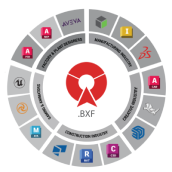
BIMDeX is one such solution with enormous potential to enhance model conversion between different CAD and BIM solutions through the proprietary BXF file format and DX cloud-based transfer.
Advancing the advent of new technologies will let us explore unprecedented routes that lead to innovations and exciting explorations at every level. Get in touch with BIMDeX and understand AI-based CAD to BIM model translation extensively.