An Engineering project demands extensive collaboration for better project flow and outcomes. Vital software solutions have become integral to various engineering projects, aiding in the design of architectural, construction, and manufacturing models. On the other hand, BIM software aids in visualizing the design models with information and sets a better stage of project management in the long run.
When the requirements arise to connect the data from different software solutions, a compatible exchange file format is required; that said, in this blog, we’ll discuss the difference between and eminence of BXF, IFC and STEP file formats in carrying model information from one software to another and its individual responsibilities in offering collaboration.
BXF, IFC and STEP File Formats
IFC and STEP file formats are already prevailing ones in the AEC, MEP, manufacturing, and construction environment, and professionals mostly sought file translations from one software to another through these formats. IFC (Industry Foundation Classes) are primarily used by AEC (Architecture, Engineering and Construction) professionals. STEP formats, on the other hand, fall under mechanical CAD, product design, and manufacturing sectors.
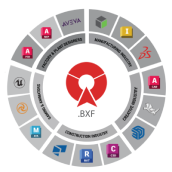
BXF is the primary proprietary file format of BIMDeX, an interoperable model conversion solution developed to bridge vital CAD and BIM solutions. BXF functions through exporter and importer plugins that are installed in the respective software applications and supports a premium model conversion experience.
Scopes of Model Conversion for Better Collaboration
Why is model conversion and collaboration intersective? A proper model conversion means the transfer of the design with the associated data from one software to another. The associated data includes parametric information, metadata, geometrical information, coordinate systems, larger models in compatible file sizes, simplified models, and more.
These scopes of model conversion catalyzes collaboration among the project teams as they can deal with credible and comprehensive information, and not just assumptions and misinterpretations. This eventually improves collective collaboration for the teams with accurate design data information and boosts overall project performance and later life cycle management.
Characteristics of BXF, IFC and STEP File formats
Before jumping into the evident collaborative efficiency of the three file formats, let us understand the characteristics of the BXF, IFC, and STEP file formats.
BXF from BIMDeX
BXF is the native proprietary file format of BIMDeX that concentrates on semantic data transfer between CAD and BIM solutions like Revit. The multi-disciplinary compatible and interoperability of the file format make it ideal for model conversion between various solutions.
BXF preserves metadata, geometry and most importantly carry parametric information during the model conversion and beyond that, the AI-ML powered model translation offers multiple perks for the industry. This perfect bridge between the CAD and BIM solutions avoids the need to rework after model conversion. On the other hand, the parametric data conversion makes it easy for the teams to update the designs even after conversion, helps a lot in design enhancement and maintain nativity.
IFC (Industry Foundation Classes)
IFC is an open standard for BIM data exchange between solutions in the AEC industry. IFC also plays a pivotal role as a format that concentrates on semantic data translation, and this is heavily used for Model coordination purposes.
Though IFC has limitations with large file sizes and geometry fidelity, the semantic data supports open BIM workflows.
STEP
Being a neutral CAD exchange file format, STEP files effortlessly move data between various mechanical and design software solutions. The format focuses on transferring all the geometrical information transfer to the other software and is widely used across CAD tools in the industry.
This geometry-focused file format does not concentrate on transferring intelligent model information and cannot play a pivotal role in project lifecycle management. Huge file size is one of the major drawbacks.
How the file formats contribute to collaboration!
As mentioned before, the file formats play a comprehensive role in stimulating better collaboration between project teams since they access the real information with better context and design data information. But we need to know how the three file formats are distinctive in terms of promoting better collaboration.
As an open standard for BIM data exchange, the IFC files promotes multi-disciplinary collaboration where architects, engineers, facility managers, contractors and more professionals bind together for the project effortlessly. Another important perspective is that IFC file formats are well known for their longevity in interoperability and support steady and extended lifecycle management. Even through the users have additional drawbacks through IFC file translation, which includes issue tracking, design enhancement etc., this is one of the widely used file formats since there is lack of interoperability solutions across cross-functional platforms.
STEP file transfers, on the other hand, are well known for their precise geometry translation in mechanical/product design software. Design validation and manufacturing workflows are the possible strengths or potential outcomes through STEP file transfers, and this is a limited collaborative perspective when compared to IFC and BXF file transfers. This limitation hinders the project requirement like BIM lifecycle management. Additionally, there are lack of usability with the translated designs such as creating single blog of geometry, distortions in geometry, limited simplification options etc.,
BXF from BIMDeX offers a collective dimension for proper collaboration by limiting the file format compatibility issue and setting a standard for transfer design data through Export and Import plugins. The friction between the CAD and BIM teams during the model translation is completely pulled down with BXF. The parametric data transfer, simplification, real data integration in the other software, undisturbed coordinates transfer, and customization at every stage make BXF a possible and potential source for impeccable collaboration for project teams who deal with CAD and BIM tools. Along with this, the revision control aspect of BXF (BIMDeX) supports incredibly well at every phase of project lifecycle management. All this makes BXF a better option for collaboration.
Closing Thoughts
The AEC, MEP, Manufacturing, and designing industries have evolved way more compared to the primitive times, where software solutions are playing predominant and pivotal roles. Since collaboration assists heavily in every stage of the industry’s projects, using or adopting a reliable file format by the respective industries is quintessential. Having said that the characteristics of BXF, IFC and STEP, it is up to the crowd to decide the compatible formats and have more reliable and standard collaboration-friendly file transfers.