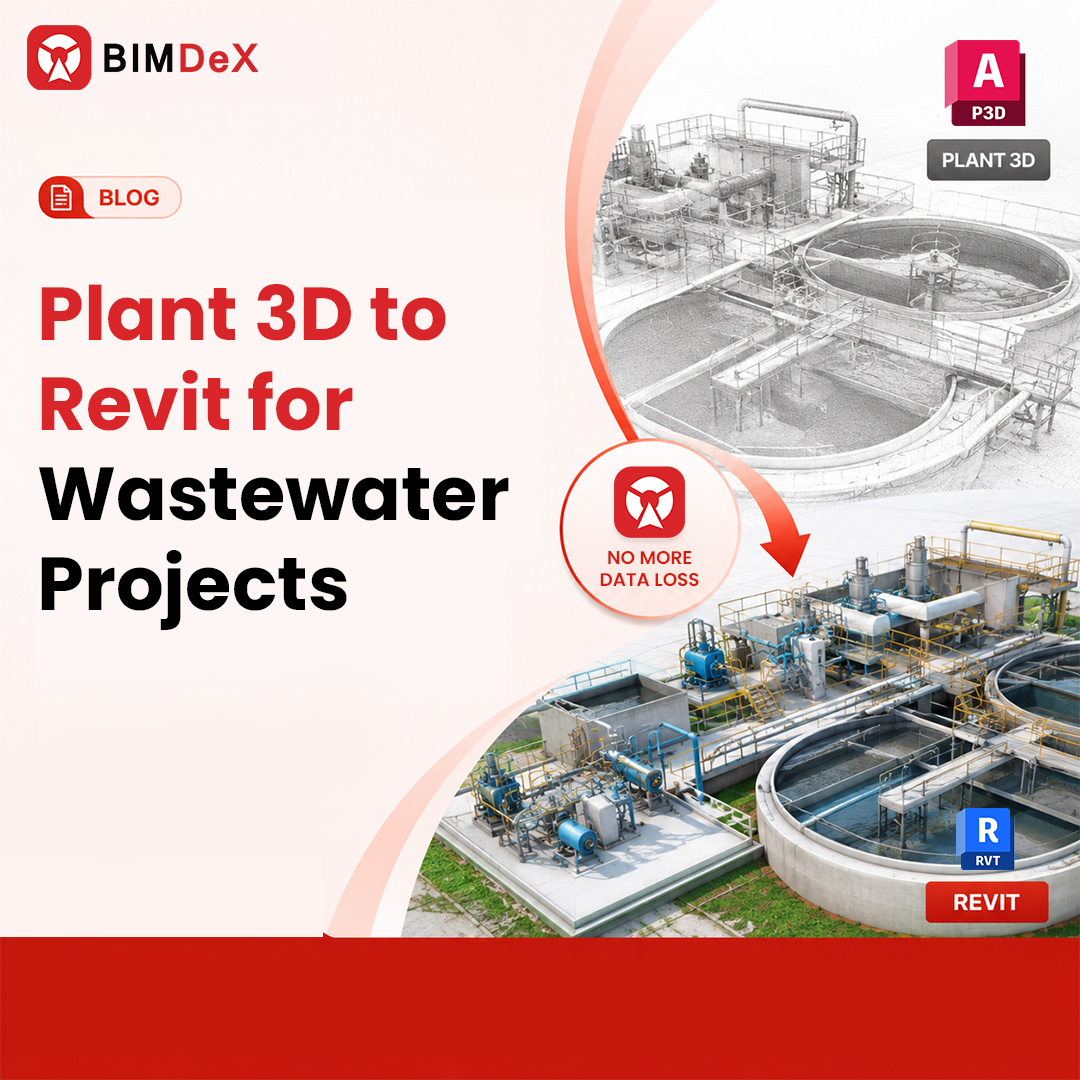
The digital transformation across the industries has enforced the demography to adopt serious changes that impact the overall workflow, leading to improved processes. Water infrastructure like wastewater industries, drinking water networks, and huge pump stations come under such industries that are slowly transforming in digital aspects, that includes creating designs and exchanging them across software applications.
Being an industry of enormous design and associated data, water demography demands a superior medium of data translation where every specific information is captured and transferred. Water industry engineers are experiencing frustrating battles with the software and the exchange process as the data gets distorted at various instances.
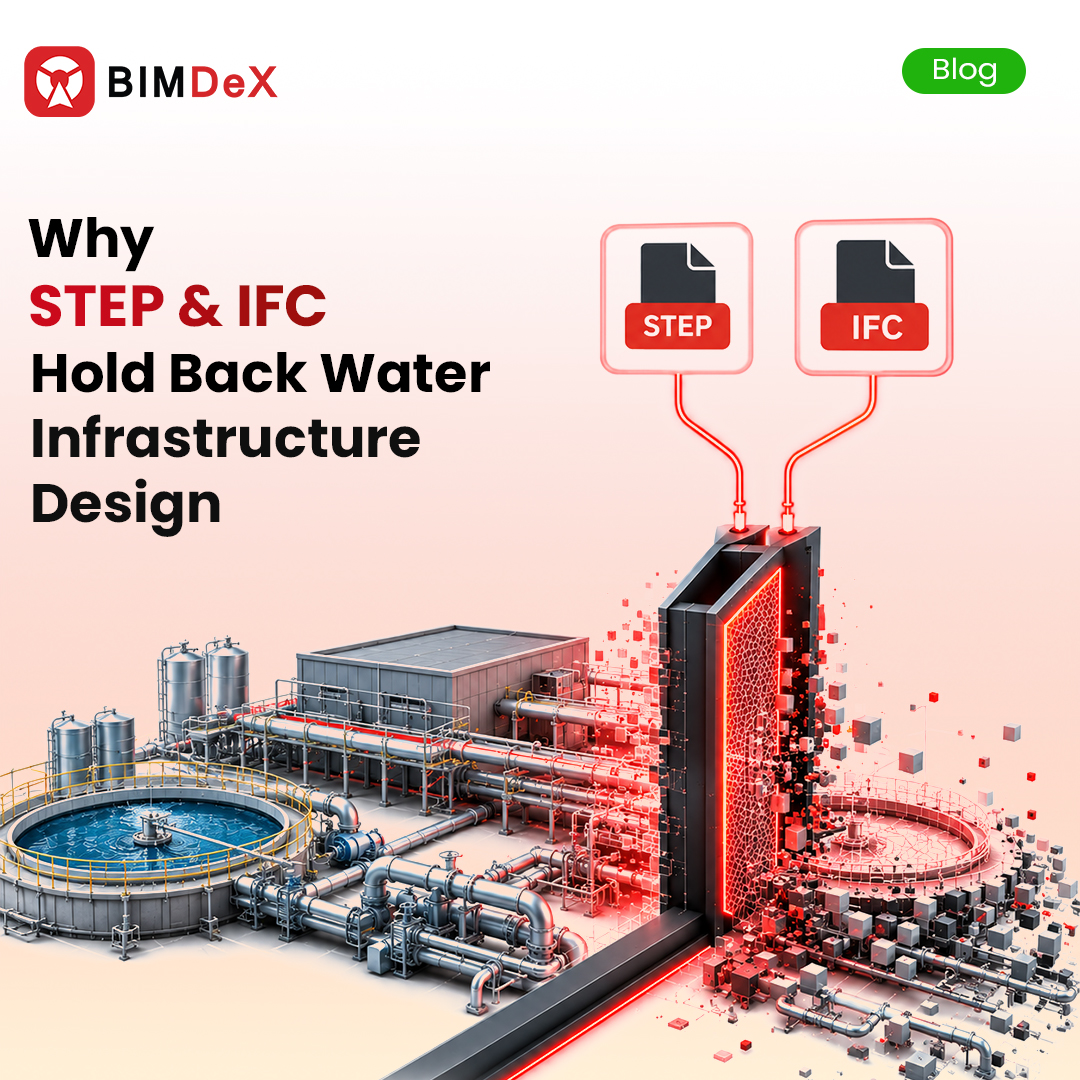
Generic file formats like STEP and IFC are eventually rupturing the data, leaving residues often, and they are holding back the water infrastructure design unfortunately. In this blog, we shall understand why the generic formats fail and how an interoperable model exchange medium like BIMDeX enhances the process industry purpose.
The Generic File Formats – STEP and IFC
Firstly, it is important to understand that the generic file formats aren’t bad; they are misapplied with the existing industries and the demography. Though the formats serve a huge purpose, they lack compatibility with the digital aspects which are the data carrying bridge nowadays.
Before addressing the limitations, we shall explore the magnificence that the formats hold and are serving the realm for decades.
STEP Format
STEP format has been the reliable format that the users prefer for manufacturing and mechanical domains. STEP files serve several benefits while converting highly complex equipment models like huge water pressure pumps and turbines.
How excellent they are!
Despite being a primitive file format, STEP format has been playing a predominant role as a breakthrough to interconnect mechanical and product design.
- STEP files are exceptionally perfect in mathematical equations to describe shapes during exchange
- STEP files serve as unified data set to transfer geometric data between applications and initiate real data conversion which earlier sought after costly intermediate vendors
- STEP protocols make sure to preserve the assembly and transfer the hierarchy as it is without flattening and maintaining the parent-child relationship intact after conversion.
IFC Format
Another reliable format with excellent ability is IFC. It is an open-standard and vendor-neutral format built to connect architects, engineers, and contractors to share 3D models and the associated data. This format holds prominence in assisting comprehensive asset management and BIM collaboration.
How excellent they are!
- IFC is known for semantic intelligence as it defines the objects or the shapes with a context. The software understands the IFC models and easily defines the shapes as wall, pump, or window.
- The open BIM standard of the file offers unified data for the professionals to collaborate with work even if they use different software vendors.
- Since IFC is open standard and true, professionals can access the information even after decades and this avoids obsolescence.
Why generic file formats fail
Though the STEP and IFC (generic formats) have been pivotal players in data exchange, they lack efficiency when it comes to water industry-based data exchange. As we know already, the water industry does not comprise just static 3D shapes; instead, it is filled with complex and dynamic interconnected systems, that include fluid dynamics and chemical pipelines and forces.
With this situation said, generic file formats like STEP and IFC cannot compensate for a credible data conversion, as it might strip the organic information and take only the mere 3D geometry.
Geometry Bottleneck
STEP file is a geometry dominant format that concentrates translating geometric information with utmost precision. But the water industry, which is beyond static buildings, requires more.
STEP file works best for mechanical and aerospace engineering, and when a water industry professional exports a pumping station, STEP file understands the curvature and transfers the accurate geometry but cannot understand what the component is and the usage. When this happens, the parametric objects are stripped and only dumb 3D geometry is transferred.
Connection Limitations
It is well known that water infrastructure is filled with relationships; having said about IFC, the format defines the objects in infrastructure like walls and windows, but for this industry its ability is not sufficient.
IFC fundamentally breaks down when it comes to linear water connection, as it cannot preserve the topology, and the logical connections between objects. When a series of pipe connections are transferred as an IFC file, the connection breaks and is exported as separate cylinders.
Inefficiency can lead to loss of prominent engineering parameters and leads to the loss of embedded data. This comprehensive loss can force the engineers to rebuild everything manually and network logic from the initial point.
Digital Twin Inefficiency
With every project moving its interest towards digital twin, water industry demands the update as the rupturing infrastructure requires advanced stations, buildings and virtual representation of the structures to have extended lifecycle management.
Unfortunately, the generic file formats do not suit and stand as a barrier for digital twin aspect for the water industry. Since STEP and IFC strip the parametric information and component metadata, it leaves only exports hollow mere 3D geometry. The team cannot extract the essential information from static geometry, and this takes the process to scratch where experts have to spend more time and cost in adding component metadata.
Collaborative limitations and huge file size
Since the generic file formats cannot transfer parametric information, they intend to define each shape like the polygon, face, and 3D model vertex. Water infrastructure like the water treatment plant will have thousands of pipes, valves, edges, connectors and more; defining each component eventually increases the file size.
Exporting such a huge file with vast information, retards the process, puts collaboration at stake and corrupts the file at last.
BIMDeX – Essential Remedy
Generic file formats rip parametric information despite being interoperable, certain middleware is high in cost and requires manual rework at certain instance; this is the situation that the water industry stays in. How about an interoperable solution that can promise ideal model conversion for the water industry, while preserving metadata, parametric information, automatically categorize components, simplify huge models into lightweight models, preserve coordinates, maintain hierarchy, cloud-based integration and a lot more?
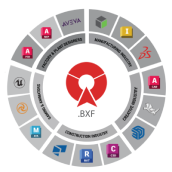
BIMDeX is one such ideal solution to deploy interoperable model conversion between applications while preserving the asset metadata. The proprietary file format called BXF works unlike other proprietary formats as it stands compatible with various software applications where the BIMDeX plugin is installed.
The increasing demand of the water industry needs an application that streamlines the workflow beyond just model conversion. Get in touch with BIMDeX and get to know more.